

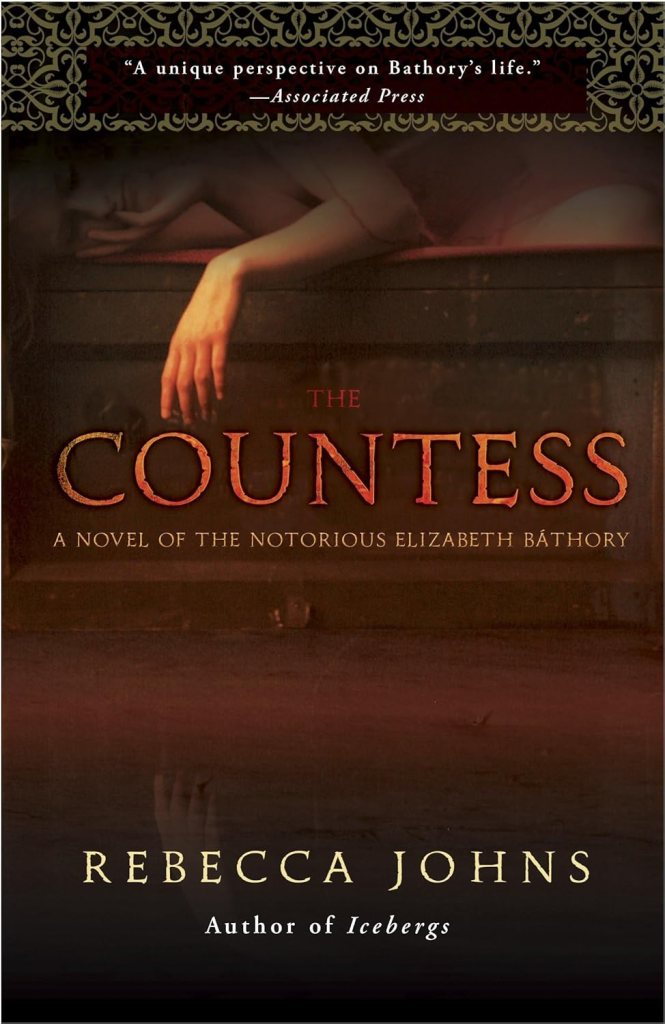
Title: The Countess
Author: Rebecca Johns
Genre: Historic, Fiction, Historical Fiction
Number of Pages: 355
My Rating: 💋💋💋💋
Book Summary:
Was the “Blood Countess” history’s first and perhaps worst female serial killer? Or did her accusers create a violent fiction in order to remove this beautiful, intelligent, ambitious foe from the male-dominated world of Hungarian politics?
In 1611, Countess Erzsébet Báthory, a powerful Hungarian noblewoman, stood helpless as masons walled her inside her castle tower, dooming her to spend her final years in solitary confinement. Her crime—the gruesome murders of dozens of female servants, mostly young girls tortured to death for displeasing their ruthless mistress. Her opponents painted her as a bloodthirsty škrata —a witch—a portrayal that would expand to grotesque proportions through the centuries.
In this riveting dramatization of Erzsébet Báthory’s life, the countess tells her story in her own words, writing to her only son—a final reckoning from his mother in an attempt to reveal the truth behind her downfall. Countess Báthory describes her upbringing in one of the most powerful noble houses in Hungary, recounting in loving detail her devotion to her parents and siblings as well as the heartbreak of losing her father at a young age. She soon discovers the price of being a woman in sixteenth-century Hungary as her mother arranges her marriage to Ferenc Nádasdy, a union made with the cold calculation of a financial transaction. Young Erzsébet knows she has no choice but to accept this marriage even as she laments its loveless nature and ultimately turns to the illicit affections of another man.
Seemingly resigned to a marriage of convenience and a life of surreptitious pleasure, the countess surprises even herself as she ignites a marital spark with Ferenc through the most unromantic of the violent punishment of an insolent female servant. The event shows Ferenc that his wife is no trophy but a strong, determined woman more than capable of managing their vast estates during Ferenc’s extensive military campaigns against the Turks. Her naked assertion of power accomplishes what her famed beauty could capturing the love of her husband.
The countess embraces this new role of loving wife and mother, doing everything she can to expand her husband’s power and secure her family’s future. But a darker side surfaces as Countess Báthory’s demand for virtue, obedience, and, above all, respect from her servants takes a sinister turn. What emerges is not only a disturbing, unflinching portrait of the deeds that gave Báthory the moniker “Blood Countess,” but an intimate look at the woman who became a monster.
My Thoughts:
I thoroughly enjoyed this novel once I became immersed in it; however, if you’re expecting a gothic tale of vampires or a fast-paced thriller about cold-blooded murders, you may find yourself disappointed.
The novel is a beautifully written fictionalized memoir of the real-life Hungarian Countess Erzsébet (Elizabeth) Báthory, infamously known as the “Blood Countess” due to the numerous young servant girls who were murdered under her care. Within the story, she is also portrayed as an “evil stepmother” figure to these girls. Though she welcomed them into her home with good intentions—offering them basic education, providing dowries, and at times even attempting to arrange marriages—any misstep on their part was met with harsh and often brutal punishment, laced with pain and deep humiliation.
The author doesn’t just paint a portrait of her cruelty, but elegantly paints a profile of a beautiful, strong, intelligent and well-educated woman. In a time where woman were coveted for their beauty and ability to bare children and provide an heir. But behind every great man, was a woman who ran the house and holdings. The Countess was a master at all of it, which I believe is what got her into trouble later in life.
However, the Countess had been through her fair share of hardships and cursed love affairs. Ultimately, every man whom she gives her love and affection to, including her son, pass her over for someone else. She fears she’ll never feel love again, and that one day she’ll be left powerless and ignored by men. This fear slowly drives her mad—until it ends, quite literally, in bloody murder.
But this isn’t a story about madness or a woman feeling sorry for herself. Instead, it’s a vivid tale of a clever, strong-willed woman trying to protect her family’s power during a time of war and shifting loyalties. The story focuses so much on her political and emotional strategies that the murders of the young girls in her care don’t come to the forefront until much later. By then, Bathory has revealed herself as smart, witty, charming, and generous—so much so that, it’s hard to believe she could truly be guilty.
The author’s focus on Countess Bathory’s childhood gives the story real depth. Without it, The Countess would be just another tale about a heartless killer—a typical, blood-soaked narrative full of violence but lacking substance.
This novel shows how deep, hidden fears can slowly damage the mind—especially when a woman like Elizabeth Bathory is forced to live under strict rules that leave her and her children vulnerable to betrayal, poverty, violence, and even death. On the surface, she seems calm and collected, but internally the pressure and fear quietly build.
In the end, Elizabeth’s violent outbursts make sense as the result of constant stress, emotional loss, and betrayal. Especially after losing some of her children and being rejected and humiliated by the men she depended on for safety.
My only critique is that the story moved a bit slowly at times, and I would’ve liked to read more about the trials involving her servants. Bathory’s fate was sealed when she was bricked into her tower, where she stayed until the end of her life.
That said, I definitely recommend this novel if you enjoy a rich, engaging historical read that leaves you questioning what really happened. The the depictions of the murders are not for the weak of heart, so be forewarned. I’ve always been fascinated by the story of Elizabeth Bathory, and this book only made me more curious. Rebecca Johns’ writing is wonderfully done, and I’ll absolutely be checking out more of her work!
Hope you enjoyed the review!
Ciao!
 Mama on the Move
You must be logged in to post a comment.